|
DID YOU KNOW?
Bald Eagles build the largest nests of any North American bird and largest tree nest for any animal species, up to 13 feet deep and 8.2 feet wide and 1.1 tons in weight.
|
|
Special Offer
Our Year of the Snake
year-long Celebration!
Buy 3 and get 1 FREE
Purchase any 3 of our
Wildlife Eye Collectible Pins
in a single order, and we'll include our Bengal Tiger Eye Wildlife Collectible pin absolutely FREE.
|
|
Did you like this issue of
Eyes Alive?
using the simple form on our website
|
|
Who Looks Cool?
If you have a picture of yourself wearing one of our Pins, T-Shirts, Hats, or carrying one of our Canvas Totes, or enjoying a cup of coffee in one of our SWaT Team Member Mugs send it to us!
If we use your photo, we'll send you a coupon for FREE SHIPPING on your next purchase!
Send your photo today!
|
|
Register to WIN!
All new accounts are automatically entered to win one of our Canvas Tote Bags. Winners are notified by e-mail.
Register NOW!
No purchase is necessary.
|
|
Help Save Wildlife
Visit Our Gift Shop
|
|
4/12/2013
DJ Geribo
We are making changes. Over the almost five years since our launch of Eye Help Animals on 08/08/08, our focus has been to tell the world the sad truths about the treatment of the wildlife that we share our planet with.
|
|
In other words, we have been in the bad news business. As someone who has supported PETA in the past and the radical demonstrations they take part in, I was often unable to even open the pages of their member magazine because of the frightful images they displayed throughout. I believe that people who know the horrific crimes that man commits against wildlife don't need to have it constantly thrust into their faces.
Therefore, from this point on, we are reporting the good news. We will still include action alerts that you can take part in to help wildlife and we will include articles that educate as well as inform the general public. But we will mostly share the good news that we hear about: the species that is no longer on the endangered list, the new polar bear cubs that were successfully born in captivity, the wildlife reserves that are succeeding against the poachers and are protecting many species that are thriving. And we will share information about the specific animals we are helping to protect, some of the most endangered of all animals on our planet.
We are also shifting our support strategy to wildlife reserves around the world that are in the field, doing the work, protecting the wildlife daily. The major corporatized organizations that serve to protect wildlife already have strong support with their own fundraising capabilities. We have concerns about where much of their money is going and that they may be funding activities in the name of 'saving wildlife' when in fact they may be supporting activities that are counter to our beliefs. We prefer to find and support the smaller organizations that so desperately need funds to feed and protect the wildlife on a daily basis.
We hope you support our changes and continue with us on our journey of "Saving Wildlife Together."
|
The Ten Trusts - Close Up (1st trust)
4/18/2013
DJ Geribo
In our last issue, I gave an overview of The Ten Trusts as told by Jane Goodall (cowritten with Marc Bekoff) in her book of the same name. Since I was inspired to now read the book, I thought I would elaborate a little more on each trust in our newsletter.
|
|
1st Trust - Rejoice that we are part of the Animal Kingdom
Although there are some who like to think that animals are completely separate and far removed from humans, we are actually close in so many ways, more than you can imagine. Not only do we share 98.7% of our genes with chimpanzees, 97.7% with gorillas, and 96.4% with orangutans, we share many emotions that have been discovered over years of research.
Many of the emotions that we share include fear, joy, happiness, embarrassment, resentment, jealousy, rage, anger, love, pleasure, compassion, respect, relief, disgust, sadness, despair, and grief. According to Jane Goodall, "it is these shared emotions, their expression, and similar physiological and anatomical bases that truly blur the borders between them and us."
Another strong bond we share with animals is an ability to form close and lasting relationships, often with members of different species. There are many case histories of dogs acting as surrogate mothers for kittens, monkeys, and other animal species. At a wildlife rehab center, a 560 lb grizzly bear befriended a kitten, sharing his meals with his tiny friend. National geographic magazine documented a play scene between a polar bear and a Canadian Eskimo dog in Canada. The play continued off and on for more than a week until the ice formed and the bear left.
|
Dominion Over the Animals
Exploitation or Responsibility
4/20/2013
DJ Geribo
Several years ago someone made a comment about the bible saying that people have 'dominion' over the animals and her interpretation was that we can do with them as we wish.
|
|
Although it was several years before Jim and I had started Eye Help Animals, I was still very concerned about the welfare of wildlife and decided not to comment because to me it was a comment someone would make out of ignorance and I wasn't interested in getting into an 'interpretation of the bible' debate. I recently thought about her statement and decided to search the internet for other interpretations besides her limited one. I found an article in the Huffington Post dated August, 2010 titled exactly what I was looking for, "The Bible and Human 'Dominion' over Animals: Superiority or Responsibility?"
The article addresses exactly what I've thought about whenever anyone talks about humans being superior to other life on earth. Interpreting biblical Hebrew may lead to the English word 'dominion' which indicates a hierarchy of some sort. But to say it means having the 'right to exploit and despoil' is not correct.
The article goes on to say that in the bible, human superiority does not refer to 'self-serving privilege but grave responsibility.'
Perhaps those who like to quote the bible and its meaning when referring to man's position in the world as the superior being over every living thing on earth, would do well to read what it actually says instead of misinterpreting the translation to serve their own views.
I would also highly recommend reading the entire article at Huffington Post by Kristen Swenson, Ph.D.
|
Good News for Leatherbacks
4/19/2013
DJ Geribo
In an effort to start our campaign off right to find more positive news items about wildlife, I searched the internet and found a great good news item about protecting wildlife.
|
|
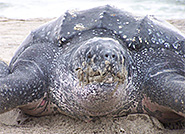
A major nesting site for leatherback turtles, the Puerto Rican Northeast Ecological Corridor that covers about 5.4 sq miles, is now protected by a new law. This law is way over-due since a battle involving developers against green activists and celebrities committed to protecting the leatherback has waged on for about 15 years.
Eye Help Animals will be including the Leatherback Turtle in its third wildlife eye collection!
|
|